Aarav Ahuja
Millets vs Whole Grains: What’s the Difference and Which Is Better?
September 12, 2026
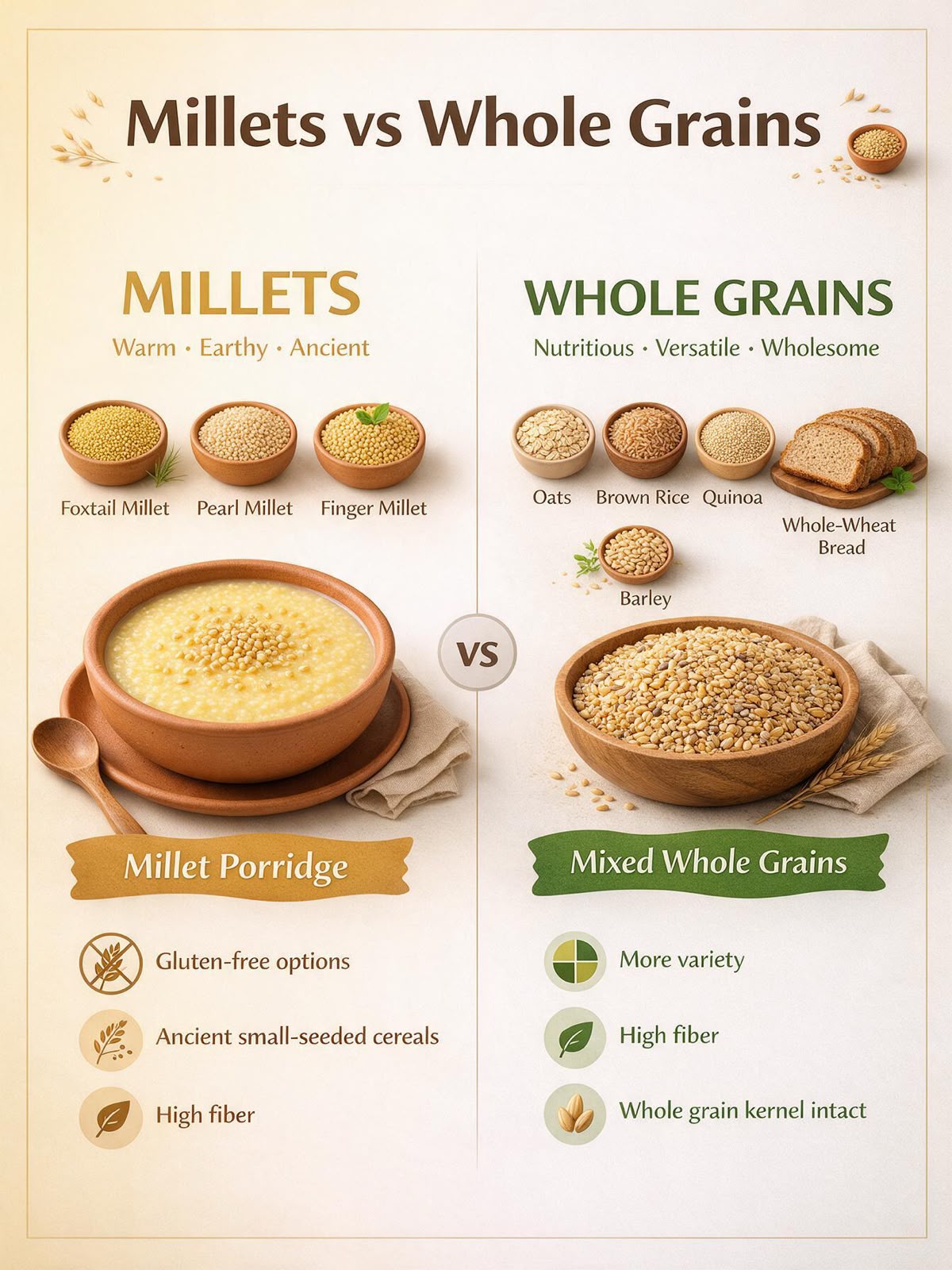
You may have noticed two terms appearing more and more on food labels: millets and whole grains.
Both are popular choices for people looking to make their everyday meals and snacks more varied. But are they the same thing? Which one is better? And how can you include them in your daily diet?
Let's make it simple.
What are whole grains?
A grain has three main parts:
- Bran – the outer layer
- Germ – the part that can grow into a new plant
- Endosperm – the main starchy part of the grain
When a grain is kept relatively intact, it is considered a whole grain.
Common whole grains include:
- Whole wheat
- Oats
- Brown rice
- Barley
- Whole corn
Whole grains can be a useful part of a balanced diet because they provide carbohydrates along with fibre and other naturally occurring nutrients.
What are millets?
Millets are a group of small-seeded cereal grains that have been grown and eaten in India for centuries.
Some familiar millets include:
- Ragi (finger millet)
- Jowar (sorghum)
- Bajra (pearl millet)
- Foxtail millet
- Little millet
- Kodo millet
Millets have traditionally been an important part of many Indian regional diets and are now enjoying renewed interest.
So, are millets whole grains?
Yes.
Millets are whole grains when consumed in their whole-grain form.
This is where the comparison can become confusing.
Millets aren't an alternative category to whole grains. Rather, millets are one type of whole grain.
Think of it this way:
Whole grains = the larger category
Millets = one group within that category
So ragi, jowar and bajra can all be part of a whole-grain diet.
Why are whole grains important?
Whole grains can contribute several important nutrients to the diet, including fibre, vitamins, minerals and other naturally occurring plant compounds.
One of the biggest differences between whole and refined grains is what happens during processing.
When grains are refined, parts such as the bran and germ may be removed, leaving mainly the endosperm.
With whole grains, these components are retained.
That's why choosing whole-grain versions of foods can be a simple way to make everyday meals and snacks more nutrient-rich.
Why are millets getting so much attention?
Millets have always been part of Indian food traditions, but they have gained renewed popularity in recent years.
There are several reasons.
They offer variety, are naturally gluten-free in their unprocessed form, and can be used in many familiar foods.
Ragi can be used in rotis, dosa, porridge and baked foods.
Jowar can be used for rotis and other preparations.
Bajra is another traditional Indian grain that can be incorporated into everyday meals.
The important thing is not to treat millets as a miracle food.
No single grain can make a diet healthy on its own.
What matters is the overall pattern of what we eat.
Millets vs whole wheat: which is better?
There isn't one universal answer.
Both can have a place in a balanced diet.
Whole wheat provides carbohydrates, fibre and other nutrients, while different millets provide their own nutritional profiles.
Rather than asking:
“Which grain is the healthiest?”
A better question may be:
“How can I include a variety of nutritious grains in my diet?”
Variety can make everyday eating more interesting while allowing you to benefit from different foods.
What about oats?
Oats are another whole grain that has become extremely popular.
They can be eaten as porridge, added to breakfast recipes or incorporated into baked foods.
Oats also contain a type of soluble fibre called beta-glucan, which is one reason they are often discussed in relation to heart health and cholesterol.
As always, the overall diet matters more than one individual ingredient.
Can you combine different grains?
Absolutely.
You don't necessarily have to choose between wheat, oats and millets.
They can all be part of a varied diet.
For example, a homemade snack could combine:
Whole wheat + ragi + oats + nuts + seeds
This is one of the ideas that inspired Earthy Crunch.
We wanted to bring together ingredients that feel familiar in Indian kitchens while creating something that people would genuinely enjoy eating.
Are millet cookies automatically healthy?
Not necessarily.
This is an important point.
Just because a biscuit or cookie contains millet doesn't automatically make it a healthy food.
A cookie can contain millet and still be high in sugar, fat or calories depending on the complete recipe.
So don't stop at the words “millet,” “multigrain” or “whole grain” on the front of a packet.
Turn the packet around.
Read the ingredient list.
Look at the nutrition information.
And consider the portion you are eating.
How to make better everyday choices
You don't need to completely change your diet overnight.
Small changes can make eating more interesting and balanced.
Try:
1. Choose whole grains more often.
Look for whole wheat, oats and other whole grains.
2. Experiment with different millets.
Try ragi, jowar or bajra in familiar recipes.
3. Eat a variety of foods.
Different grains, vegetables, fruits, pulses, nuts and seeds can all contribute to a balanced diet.
4. Read food labels.
Don't rely only on words such as “healthy” or “multigrain.”
5. Remember that portions matter.
Even foods made with nutritious ingredients should be enjoyed in appropriate amounts.
The Earthy Crunch Approach
At Earthy Crunch, we believe better snacking starts with understanding what goes into your food.
That's why we use ingredients such as whole wheat, millets, oats, nuts, seeds, jaggery and desi ghee across our range.
We aren't trying to make food complicated.
We're simply trying to make everyday cookies with ingredients that people recognise and enjoy.
Because food should be nourishing, but it should also be delicious.
The Bottom Line
Millets and whole grains aren't competitors.
Millets are a group of whole grains.
Both can be valuable parts of a varied, balanced diet.
Instead of searching for one “perfect” grain, focus on variety, minimally refined ingredients where appropriate, balanced meals and sensible portions.
And the next time you see ragi, jowar, oats or whole wheat on an ingredient list, you'll know a little more about what you're looking at.
Frequently Asked Questions
Are all millets whole grains?
Millets are whole grains when they are consumed in their whole-grain form. Processing can change the form and nutritional characteristics of a grain.
Is ragi a whole grain?
Yes. Ragi, also known as finger millet, is a whole grain when consumed as the whole grain.
Is jowar a whole grain?
Yes. Jowar, or sorghum, is a cereal grain and can be consumed as a whole grain.
Are oats whole grains?
Yes. Whole oats are whole grains.
Are millet cookies better than regular cookies?
Not automatically. The nutritional value of a cookie depends on its complete ingredient list, recipe, portion size and overall diet—not simply whether it contains millet.
Can I eat both wheat and millets?
For most people, there is no need to choose one exclusively. Including a variety of grains can be part of a balanced eating pattern.
Explore Earthy Crunch
Discover our range of cookies made with thoughtfully selected ingredients, including whole grains, millets, oats, nuts, seeds, jaggery and desi ghee.